terça-feira, 10 de maio de 2011

cronofotografia (tentativas de registro)

André Cadere

Fonte: http://looksee.chrisashley.net/?p=486

andrecadere1.jpg
From “André Cadere: Peinture sans fin”
André Cadere became well known in the 1970s with his “barres de bois rond” – round painted wood bars of varying sizes – which were minimalist art objects as well as instruments of artistic intervention. Handmade by the artist, the bars were composed of painted cylindrical segments, whose height corresponded to their radius. The individual units were assembled following a mathematical system of permutation whose logical sequence was disturbed by one error respectively.
Cadere referred to his wood bars as “peinture sans fin” – “unlimited painting” – which redefined the boundaries of the medium and broke with traditional ways of seeing. The form of the rod does not prescribe a privileged point of view – it has no front nor back, no bottom nor top – but offers itself to multiple presentations instead: The bars can be laid out on the floor, fixed to the wall or can lean against it; they can also, theoretically, be moved from one place to another.
The aspect of mobility plays an important role in Cadere’s conceptual approach: In his “promenades-performances”, the artist walked – bar in hand – through the urban context, “occupying” with it public spaces (such as the street, the subway or a restaurant) and thus demonstrating the relative independence in the presentation of his art from the institutional context. At the same time, Cadere attended – whether invited or not – openings of gallery and museum exhibitions (such as, for instance, in 1972 documenta 5), in order to present his wood bars and get the public involved in discussions about his work.
andrecadere3.jpg

Michelangelo Pistoletto

"Learning by doing"
"Bringing the people together, this is important in art" - Michelangelo Pistoletto

Fonte: http://www.philamuseum.org/exhibitions/414.html?page=4 (cf. vídeo)

Scultura da passeggio (Walking Sculpture) with Michelangelo Pistoletto


Saturday, October 30, 2010
1:30 p.m. Procession departed from the Museum’s West Entrance.
2:00 p.m. Rittenhouse Square
2:30 p.m. City Hall
3:00 p.m. Rodin Museum
In 1967, Pistoletto rolled a giant ball of newspapers through the streets of Turin. In the fall of 2010, Pistoletto rolled a contemporary replica of the newspaper sphere by Spiral Q Puppet Theater out of the Museum and onto the streets of Philadelphia. The procession made its way along major streets in the city with a few special stops along the way.

Krzysztof Wodiczko

Krzysztof Wodiczko was born in 1943 in Warsaw, Poland, and lives and works in New York and Cambridge, Massachusetts. Since 1980, he has created more than seventy large-scale slide and video projections of politically-charged images on architectural façades and monuments worldwide. By appropriating public buildings and monuments as backdrops for projections, Wodiczko focuses attention on ways in which architecture and monuments reflect collective memory and history. In 1996 he added sound and motion to the projections and began to collaborate with communities around chosen projection sites, giving voice to the concerns of heretofore marginalized and silent citizens who live in the monuments’ shadows. Projecting images of community members’ hands, faces, or entire bodies onto architectural façades, and combining those images with voiced testimonies, Wodiczko disrupts our traditional understanding of the functions of public space and architecture. He challenges the silent, stark monumentality of buildings, activating them in an examination of notions of human rights, democracy, and truths about the violence, alienation, and inhumanity that underlie countless aspects of social interaction in present-day society. Wodiczko has also developed ‘instruments’ to facilitate survival, communication, and healing, for homeless people and immigrants. These therapeutic devices, which Wodiczko envisions as technological prosthetics or tools for empowering and extending human abilities, address physical disability as well as economic hardship, emotional trauma, and psychological distress. Wodiczko heads the Interrogative Design Group and is Director of the Center for Art, Culture, and Technology, formerly known as the Center for Advanced Visual Studies, at the Massachusetts Institute of Technology. His work has appeared in many international exhibitions, including the São Paulo Bienale (1965, 1967, 1985); Documenta (1977, 1987); the Venice Biennale (1986, 2000); and the Whitney Biennial (2000). Wodiczko received the 1999 Hiroshima Art Prize for his contribution as an artist to world peace, and the 2004 College Art Association Award for Distinguished Body of Work.
Fonte: http://www.pbs.org/art21/artists/wodiczko/

Homeless Car:
Entrevista onde ele explica sua ligaçao com Brecht e seu trabalho:

http://www.ina.fr/art-et-culture/beaux-arts/video/I08051804/krzysztof-wodiczko-et-son-baton-d-etranger.fr.html

sábado, 7 de maio de 2011

terça-feira, 3 de maio de 2011

experimento coletivo 1]: re-enactment de erwin wurm

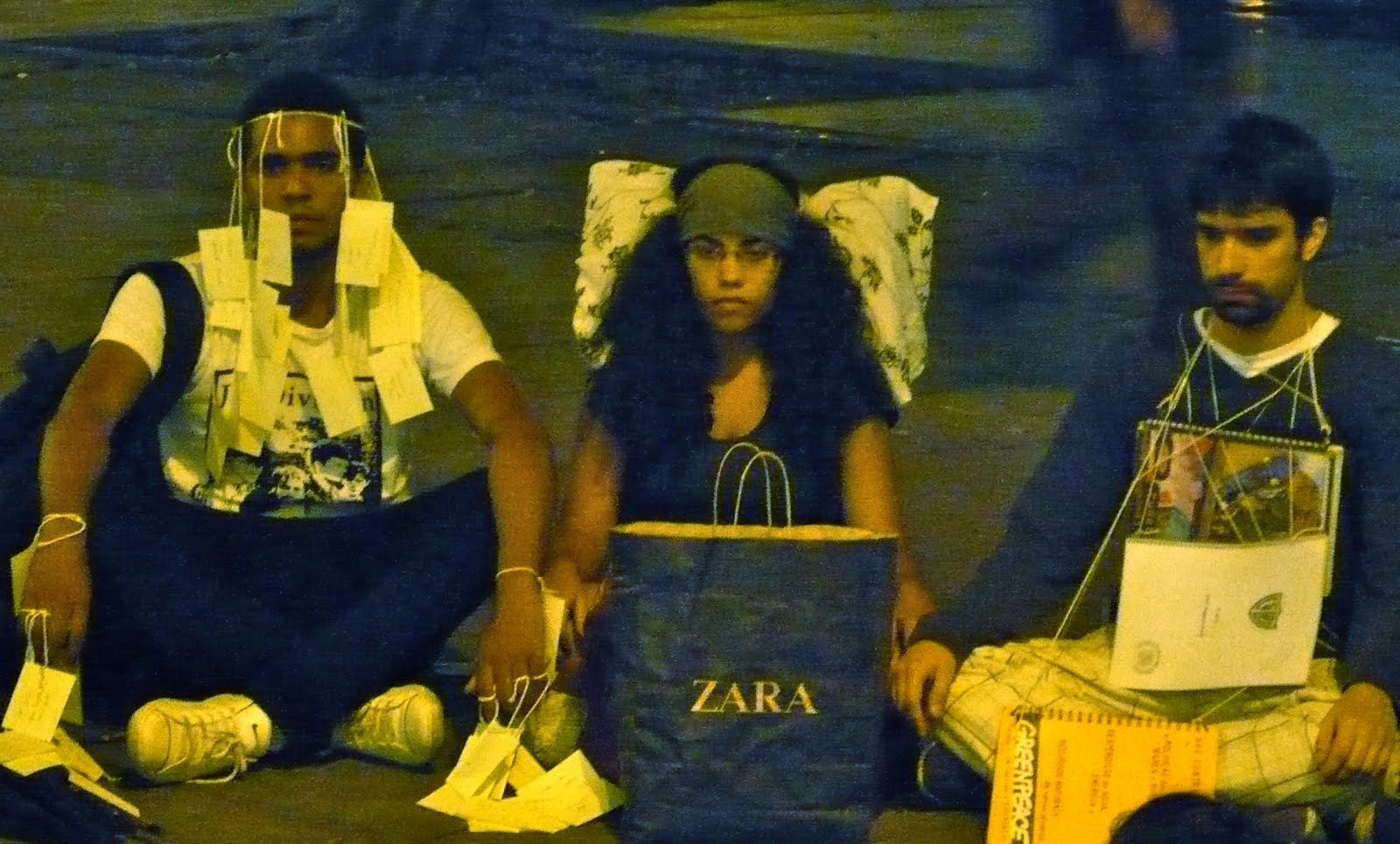
A Performance é um re-enactment coletivo do trabalho de Erwin Wurm e tenta responder a pergunta de cada performer sobre: o que andamos arrastando na vida?
Performers: Carolina Riscado, Guilherme Terreri, Isabel Maciel, Jefferson de Souza, Lara Paciello, Lis Mainá, Lucimar Ferreira, Manoela Pereira, Marcos Vinicius Pereira, Miguel Araújo, Priscila Cavalcanti, Renata Sampaio, Tania Alice.


Fotografia: Maria Castro.